|
The existing system at a food factory in Foshan used chilled water for cooling and dehumidification, and used cooling water return heat to raise the temperature for temperature and humidity control. During high-humidity periods such as the plum rain season and the returning-south damp weather, workshop humidity easily exceeded the limit, requiring additional ordinary industrial dehumidifiers. The project adopted one 5RT inverter heat pipe dehumidification heat pump for an energy-saving retrofit, improving humidity treatment efficiency while reducing insulation, maintenance, and dehumidification energy costs.
3.53% → 61.12%
Effective cooling capacity for humidity treatment |
68.5%
Estimated energy-saving rate compared with conventional solutions |
19.8℃
Annual average wet-bulb temperature in Foshan |
30㎡
Coverage area per unit |
01 | Customer Pain Points
- The original system used chilled water for cooling and dehumidification, and used cooling water return heat to raise the temperature for temperature and humidity control; during the plum rain season and returning-south damp weather, humidity in some areas did not meet the standard, and the humidity control of the custom air handling cabinets failed.
- The system required chilled water pumps and cooling water pumps. The central air-conditioning cooling water first passed through the constant-temperature and constant-humidity air handling cabinets, then entered the cooling tower for cooling; the cooling water temperature was fixed at 30℃ inlet and 35℃ outlet.
- Conventional chilled water dehumidification efficiency is low. Under the 24℃/45% condition, only about 3.53% of most of the cooling capacity is effectively used for humidity treatment.
- Chilled water pipes need to be wrapped with insulation cotton, which is easily damaged and produces condensate dripping into the workshop, failing to meet the hygiene requirements of food factories; at the same time, high-power water pumps are required, and the insulation cotton is replaced every dozen years or so, costing up to more than 100,000 yuan.
- Desiccant wheel dehumidifiers consume large amounts of energy and have high maintenance costs. Conventional equipment also requires additional cooling capacity and steam, consuming about 3-4 tons of steam per day; the wheel core is replaced about every 7 years, costing up to hundreds of thousands of yuan.
- When ordinary industrial dehumidifiers control humidity alone, the rated performance is 2.1 kg/kW, i.e., an input of 1 kW yields a dehumidification capacity of 2.1 kg/h.
- There is only one aging workshop, sugar materials are moved frequently, and labor costs continue to rise. The required temperature and humidity for general workshops are 22-24℃ / 42-50%.
02 | Solution Comparison
Differences from ordinary constant-temperature and constant-humidity air handling cabinets
| Comparison item |
Conventional ordinary air handling cabinet |
Heat pipe solution |
| Cooling and dehumidification method |
Chilled water dehumidification, cooling water return heat for temperature rise |
Heat pipe combined with condensing heat recovery reheat; excess heat removed by outdoor heat exchanger or water |
| Effective cooling capacity for humidity treatment |
About 3.53% |
61.12%, about 17 times that of conventional solutions |
| Water-cooled pipe insulation |
Insulation cotton required |
No insulation required |
| Engineering workload and maintenance |
Insulation cotton damage and periodic replacement costs |
Low engineering workload and low maintenance costs, with no mandatory periodic insulation cotton replacement expenditure |
Differences from ordinary industrial dehumidifiers
Taking the 27℃/70% condition as an example, the dehumidification capacity-to-power ratio of the heat pipe inverter dehumidification heat pump is 4.4 kg/kW, while that of an ordinary industrial dehumidifier is 2.1 kg/kW. An input of 1 kW yields a dehumidification capacity of about 4 kg/h, twice that of the ordinary solution.
An input of 1 kW can also simultaneously provide 5 kW of cooling capacity. The combined solution of an ordinary industrial dehumidifier and an air conditioner requires about 3.18 kW of input power to achieve the same effect (air conditioner COP estimated at 5.0), while our solution can achieve an energy-saving rate of up to 68.5%.
03 | Humidity Treatment Power Consumption Comparison
Taking the 25℃/45% return air condition as an example, with constant-temperature supply air. In actual operation, if constant-temperature supply air is not required, the total power will differ from the results in the table.
| Deep cooling temperature |
Effective cooling utilization |
Cooling capacity required for 50 kg/h |
Heat required for temperature rise |
Required air volume |
Converted cooling source power |
Electric heating |
Total power |
| 12℃ |
3.53% |
424.70 kW |
380.00 kW |
8,500 CMH |
86.36 kW |
380.00 kW |
466.36 kW |
| 2℃ |
61.12% |
105.00 kW |
69.00 kW |
9,000 CMH |
6.90 kW |
0.00 kW |
6.90 kW |
04 | Key Operating Data
| Indicator |
Project performance |
Description |
| Effective cooling capacity for humidity treatment |
3.53% → 61.12% |
About 17 times that of conventional chilled water solutions |
| Dehumidification capacity-to-power ratio |
2.1 → 4.4 kg/kW |
An input of 1 kW yields a dehumidification capacity of about 4 kg/h |
| Comprehensive energy-saving rate |
68.5% |
Relative to the combined solution of ordinary industrial dehumidifier + air conditioner |
| Low-humidity condition |
About 7 kg/h |
25℃/45% circulating air condition |
| Coverage area per unit |
About 30㎡ |
When enclosed, with no exhaust and no heat-generating equipment |
| Equipment energy consumption |
About 10% of desiccant wheel equipment |
Maintenance only requires periodic filter replacement and heat exchanger cleaning |
05 | Unit Specifications
| Item |
CFZ6.3B |
NX-FL2000BP-5
Water-cooled |
NX-FL2000BP-5
Air-cooled integrated |
NX-FL2000BP-5
Air-cooled split |
Nominal dehumidification capacity
RH60%/27℃ |
6.3 kg/h |
10 kg/h |
10 kg/h |
10 kg/h |
Nominal dehumidification capacity
RH70%/27℃ |
8 kg/h |
11 kg/h |
11 kg/h |
11 kg/h |
| Power supply |
3N~380V/220V ±10% |
3N~380V/220V ±10% |
3N~380V/220V ±10% |
3N~380V/220V ±10% |
| Frequency |
50 Hz |
50 Hz |
50 Hz |
50 Hz |
| Rated current |
7 A |
3.9 A |
5.51 A |
5.51 A |
| Rated input power |
3.8 kW |
2.5 kW |
3.5 kW |
3.5 kW |
| Maximum input power |
4.36 kW |
3.20 kW |
3.70 kW |
3.70 kW |
| Power factor |
0.80 |
0.98 (all brushless motors) |
0.98 (all brushless motors) |
0.98 (all brushless motors) |
| Circulating air volume |
1,800 m³/h |
500-2,000 m³/h
EC inverter condition adaptation |
500-2,000 m³/h
EC inverter condition adaptation |
500-2,000 m³/h
EC inverter condition adaptation |
| Suction/discharge pressure |
0.60 / 1.88 MPa |
0.60 / 2.10 MPa |
0.60 / 2.30 MPa |
0.60 / 2.30 MPa |
| Noise |
≤60 dB(A) |
≤60 dB(A) |
≤60 dB(A) |
≤60 dB(A) |
| Mass |
132 kg |
200 kg |
200 kg |
200 kg |
Dimensions
Depth×Width×Height |
430×600×1,920 mm |
1,068×468×1,694 mm |
1,068×468×1,694 mm |
1,068×468×1,694 mm |
06 | Project Value and Case Endorsement
The annual average wet-bulb temperature in the Foshan area is about 19.8℃. After adopting the inverter dehumidification heat pump controlled by wet-bulb temperature, there is no need to operate the cooling water at a fixed 30℃/35℃, and the central chiller is expected to reduce energy consumption by about 24.4%.
- Has supplied Dongguan Hsu Fu Chi for the eighth consecutive year; multiple workshops use our equipment and are gradually replacing Munter's desiccant wheel dehumidifiers and Hitachi's chillers.
- The custom equipment for a sports equipment company in Guangdong has statistical operating data, saving more than one million RMB in electricity costs per year.
07 | Solution and On-site Acceptance
After a detailed analysis of customer pain points, operating conditions, and equipment parameters, this project is equipped with one water-cooled 5RT inverter heat pipe dehumidification heat pump.
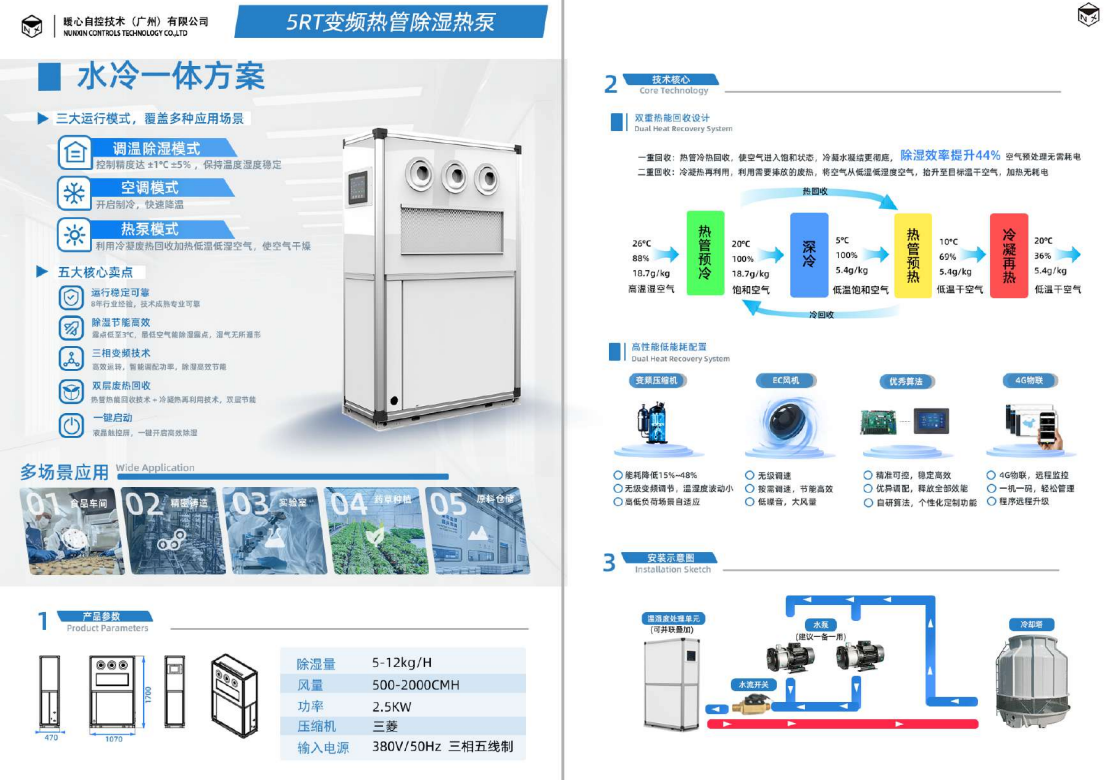
5RT water-cooled inverter heat pipe dehumidification heat pump system diagram
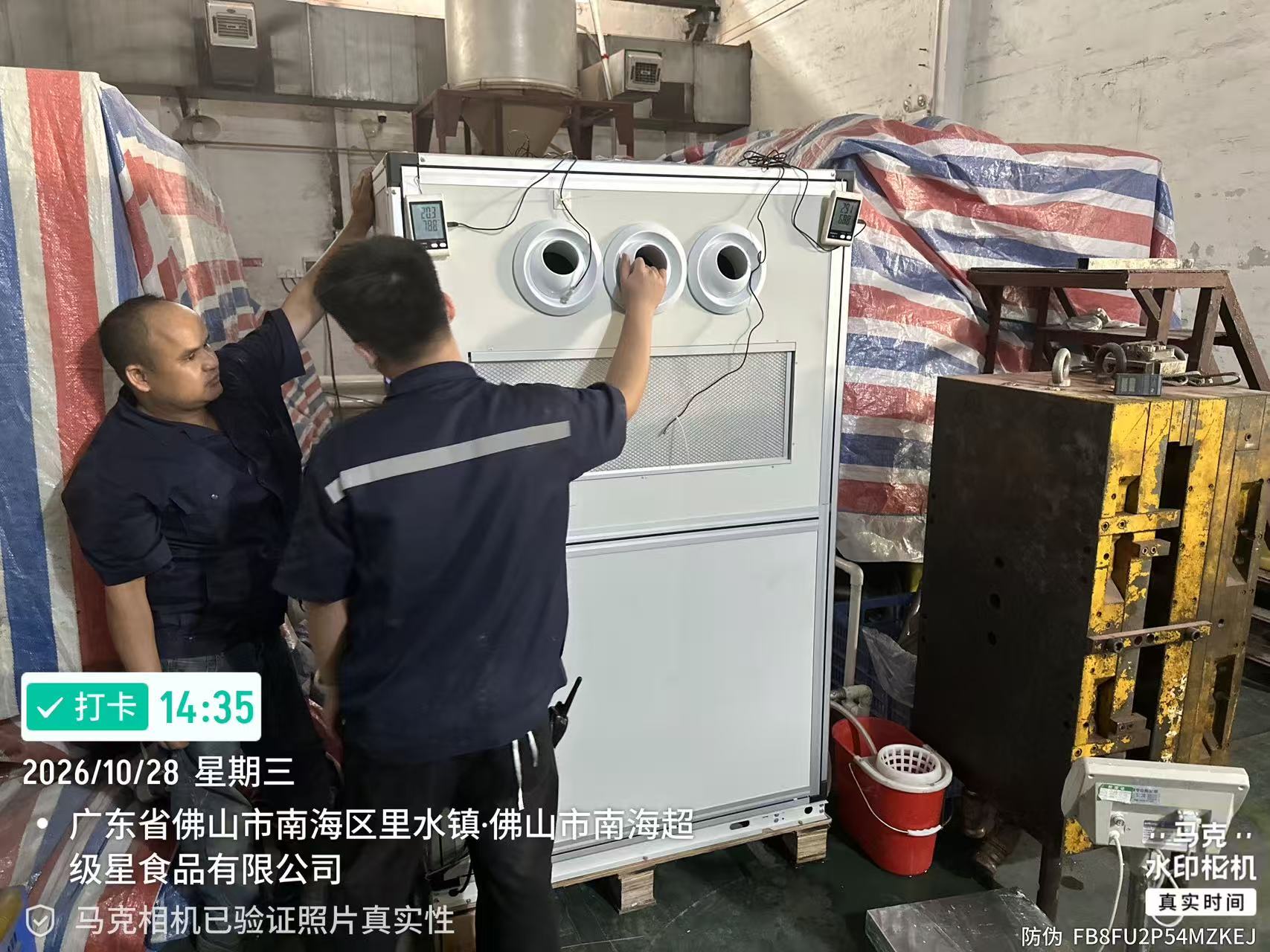
On-site installation and acceptance |
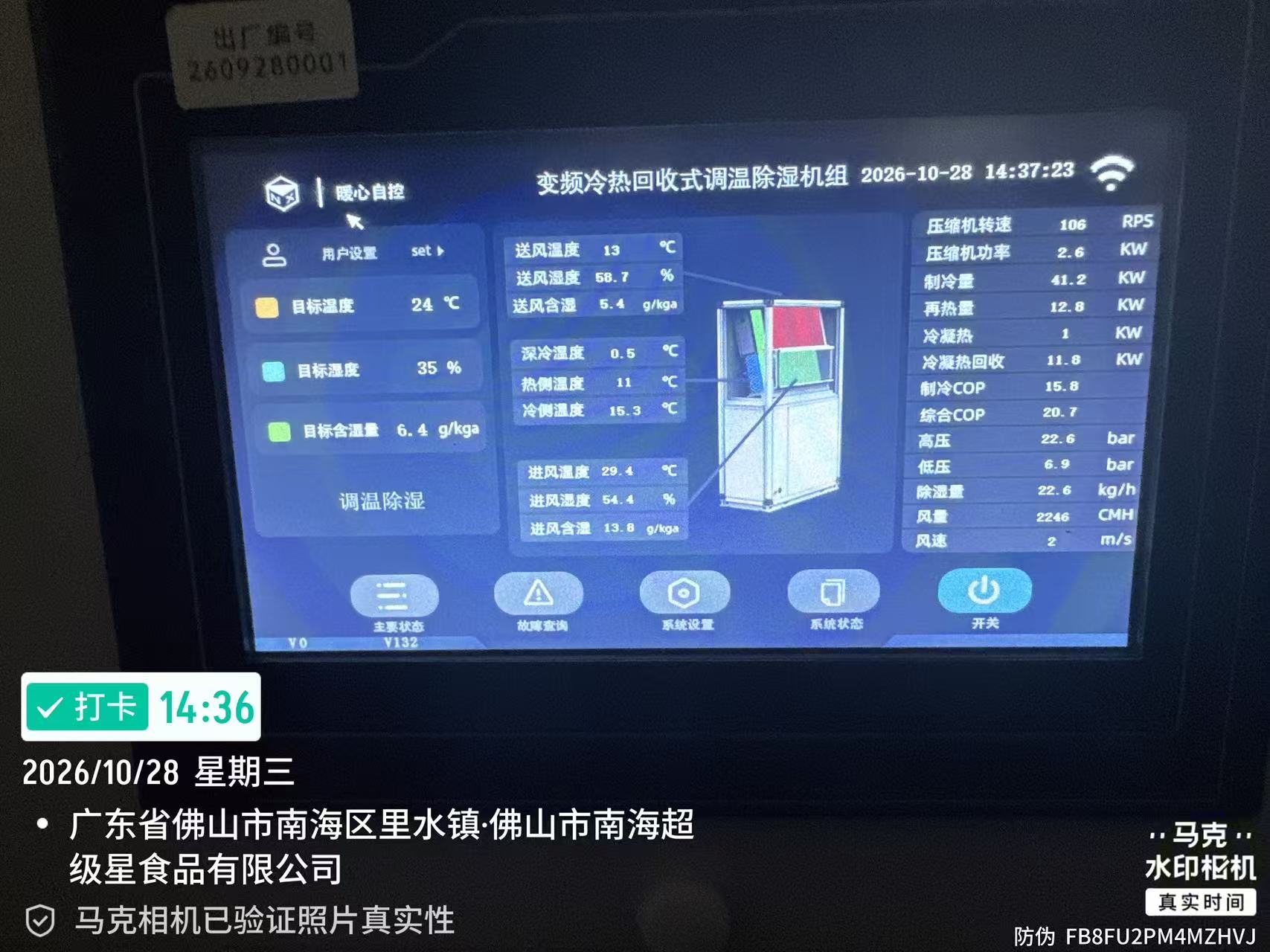
Equipment operation site |
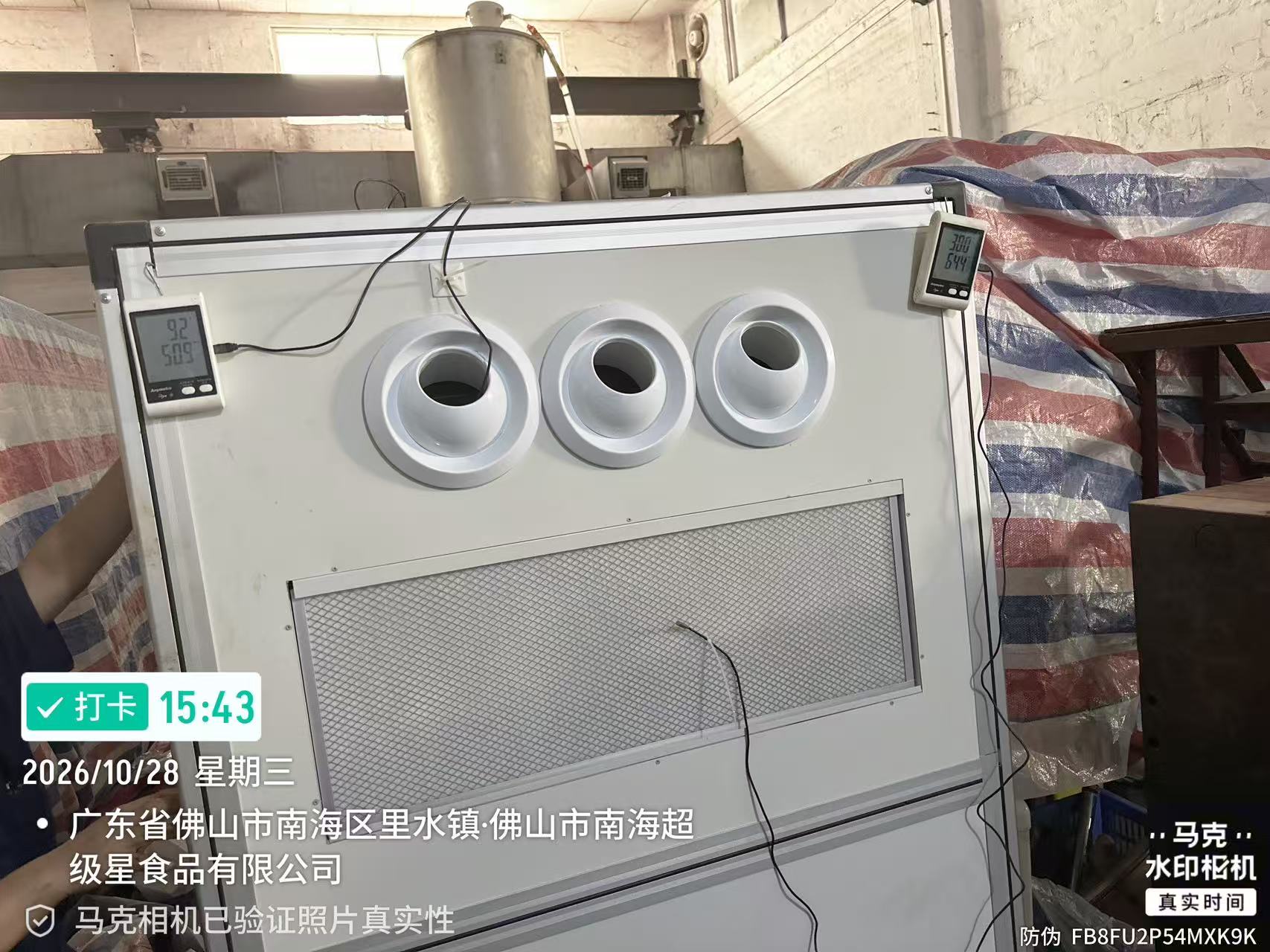
Equipment and piping layout |
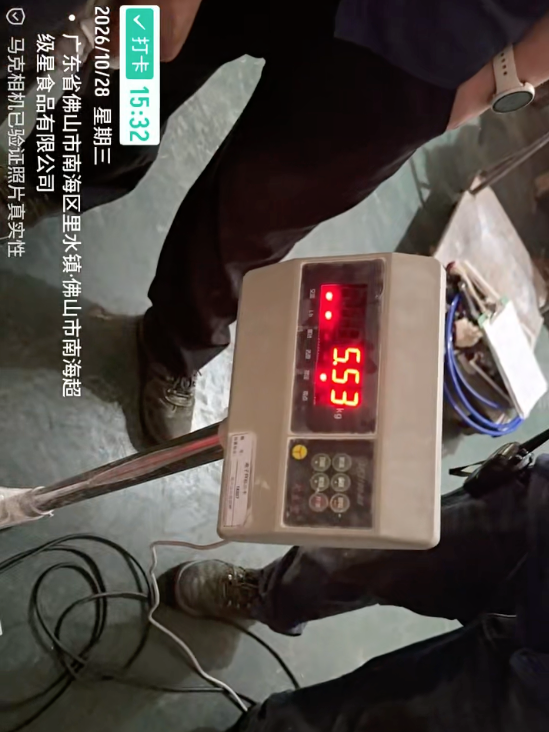
Dehumidification capacity weighing test |
|